At KVC, we want every child and adult to be safe & connected to a strong family and a healthy community. We’re proud to be a leader in innovative, effective and compassionate care.
Services Near You
Kansas
Nebraska
We also provide consultation and training through the KVC Institute. Learn more about our software and technology.


History
Last year, KVC grew in exciting ways. We welcomed 800 employees from St. Louis, MO-based nonprofit Great Circle into KVC Missouri, and we’re honored to carry Great Circle’s mission forward.
We also announced a joint venture with Children’s Mercy Kansas City to open a new 72-bed, world-class, inpatient mental health hospital in Olathe, KS.
Meanwhile, we’ve continued deepening our partnerships and reach in Kansas, Kentucky, West Virginia, and Nebraska.
See this timeline of the children’s charities that chose to become part of KVC:
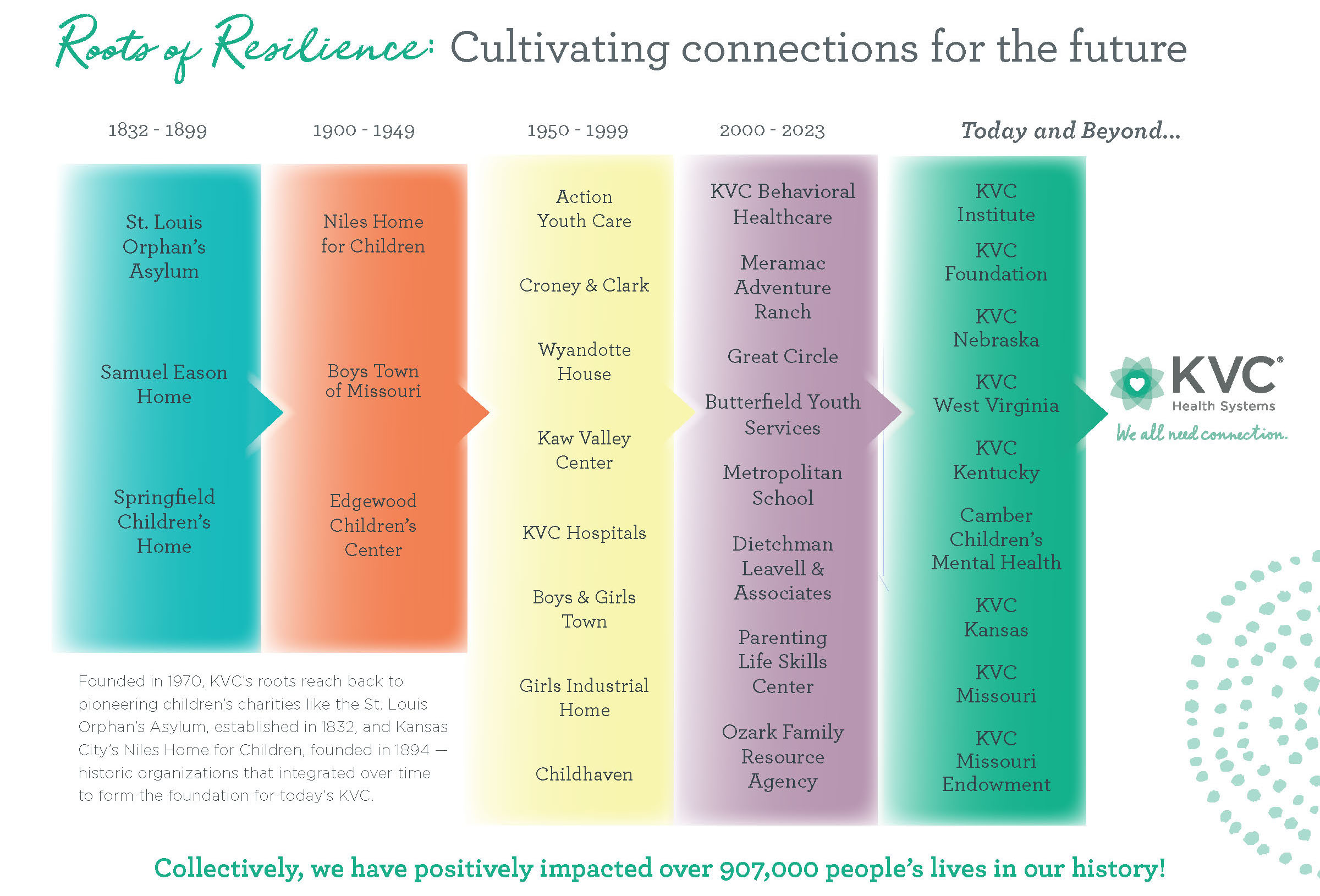
Nearly 200 Years of Heart-Centered Service
KVC stands on the shoulders of pioneering children’s charities like the St. Louis Orphan’s Asylum (established in 1832) and Kansas City’s Niles Home for Children (established in 1894), historic organizations that integrated over time to form the foundation for today’s KVC. We’re honored that the boards, leaders, and supporters of these organizations chose to become part of KVC because of our shared mission, vision and values. We intend to honor their legacy.
In 2020, we created a short video for KVC’s 50th anniversary since our founding in Kansas City, Kansas. Check out our history of providing heart-centered service to children and families:
Historic Milestones in KVC’s History
1832 – St. Louis Orphan’s Asylum Founded
The organization with the longest roots in KVC history is the St. Louis Orphan’s Asylum. It later became Edgewood Children’s Center (1943), integrated other nonprofits over time, eventually becoming Great Circle (2009) and then KVC Missouri (2023). We honor all the leaders, employees and supporters from nearly 200 years of history.
1894 – Kansas City’s Niles Home for Children Founded
The next organization with long roots in KVC’s history is Niles Home for Children. It was founded by Samuel Eason. Niles became part of KVC Missouri in 2016.
1970 – KVC Founded in Kansas City, Kansas
What is now KVC Health Systems started in 1970 as Wyandotte House in Kansas City, Kansas. It was created by the Junior League of Kansas City, the Ball family and many other community volunteers to help children who were victims of abuse, but being housed in a detention center. Read more about KVC’s early days.
1980 – New Leadership
Wayne Sims joined the organization in 1980 as President and CEO. He served for the next 35 years, contributing some of the organization’s guiding philosophies including, “What would you want for your child?” and “There is no magic answer down the street.” Read more about Sims’ legacy of caring.
1991 – Gold Seal of Accreditation & Children’s Treatment
KVC became accredited by The Joint Commission, considered the gold standard in healthcare. Also the KVC subsidiary now called Camber Children’s Mental Health began, then called KVC Hospitals. This organization provides high-quality children’s inpatient psychiatric and residential treatment.
1994 – Kaw Valley Center
In 1994, Wyandotte House changed its name to Kaw Valley Center. Learn more about the evolution of KVC’s name.
1995 – Building a Proven Track Record
From 1980 to 1995, KVC grew to represent one of the strongest child welfare and behavioral healthcare continuums of care in the nation, allowing KVC to meet the needs of any child and family requiring mental or behavioral health treatment, and adopted a philosophy of treating any child in need, including those with the most complex needs. KVC has emphasized continual research and education, often drawing upon national experts and evidence based practices in its effort to serve all children and families.
1996 – Child Welfare Privatization in Kansas
The Kansas Department for Children and Families (then known as SRS) initiated the privatization of the state’s child welfare services. In that initiative, case management and other direct services formerly provided by the State were contracted to private not-for-profit social service organizations. KVC was selected as one of the first lead providers for the family preservation contract. As of 2023, KVC is the only private, nonprofit organization in the U.S. that has continuously provided foster care case management services for over 25 years.
2000 – Expansion into West Virginia
KVC initiated in-home therapy and child placing agency services (recruiting, licensing, training and supporting foster families) to serve thousands of children in the state of West Virginia.
2003 – KVC Behavioral HealthCare (now KVC Kansas)
To better reflect the organization’s national reach, Kaw Valley Center was renamed KVC Behavioral HealthCare, now known as KVC Kansas. From 2003, “KVC” no longer stood for specific words, however the organization often uses the phrase “Knowledge, Values, Connections” to help tell its story.
2004 – Olathe, Kansas Headquarters
KVC successfully completed a $9 million campaign to construct a facility in Olathe, Kansas which serves as KVC’s headquarters and also houses the Ball Event Center.
2005 – Adoption Services
KVC became responsible for helping children in foster care to be adopted into forever families when this was added into the foster care/reintegration contracts in Kansas. Meet children waiting for adoptive families here.
2006 – First Children’s Psychiatric Hospital
The Kansas Department for Children and Families awarded a grant to KVC to provide acute, inpatient services to children and adolescents from across eastern Kansas at Camber Kansas City (then called KVC Hospitals). This psychiatric hospital program serves children and adolescents who are experiencing a mental health crisis. This program has been tremendously successful, offering a child- and family- friendly treatment program.
2008 – National Recognition
The Annie E. Casey Foundation identified KVC for representing innovation and best practice approaches in child- and family-serving work. Also that year, KVC created the parent organization, KVC Health Systems, which provides administrative services support to subsidiary organizations. (As of 2023, KVC’s subsidiaries include Camber Children’s Mental Health, KVC Kansas, KVC Missouri, KVC Nebraska, KVC Kentucky KVC West Virginia. and the KVC Foundation. All entities work together under a common vision and mission to enrich and enhance the lives of children and families.)
2009 – Nebraska and Kentucky
KVC initiated foster care/child placing agency and in-home therapy services in Nebraska. KVC also expanded its service reach to include Kentucky, where it provides in-home therapy, family preservation programs and, at that time, foster care/child placing agency services.
2010 – Western Kansas Expansion
KVC opened what is now Camber Hays, then known as KVC Hospitals, to provide children’s psychiatric treatment to youth in this more rural area of the state.
2011 – Adoption Celebration
KVC hits a milestone, celebrating 1,500 children’s adoptions in 1,500 days.
2012 – Washington, D.C.
Washington, D.C.’s Child and Family Services Agency hires KVC to provide consulting services, share best practices and improve outcomes for children.
2013 – First Child Trauma Training Center
KVC announced the NYU/KVC Midwest Trauma Training Center in collaboration with New York University and Dr. Glenn Saxe, Director of the NYU Child Study Center and founder of Trauma Systems Therapy. In 2013, KVC also completed a major rebranding, launched a new website, and began publishing across seven blogs. See one positive results of KVC’s trauma-informed care work here: First Ever Study of Trauma-Informed Foster Care Shows Stunning Results.
2014 – New KVC Institute Planned
Thanks to the generosity of many businesses, foundations, families and employees, KVC broke ground on its new KVC Institute planned for a Spring 2015 open. Also KVC began providing consulting to the country of Singapore in Southeast Asia.
2015 – KVC Institute Opens
The hub of the KVC Institute for Health Systems Innovation, called the KVC Sims Family Center, opens. It is adjoined to the KVC Health Systems headquarters building in Olathe, Kansas.
2016 – Jason Hooper, KVC’s 2nd CEO
Jason Hooper becomes President/CEO of KVC Health Systems, succeeding Wayne Sims who served in the role for an incredible 35 years. Also in 2016, Niles joins the KVC Health Systems family, offering day and residential treatment services to children and adolescents in the heart of Kansas City, Missouri.
2019 – Wichita, Kansas Hospital
Thanks to generous philanthropic supporters, Camber Wichita (then called KVC Hospitals) opened to provide inpatient children’s psychiatric treatment. In total, due to changes at all locations, KVC/Camber added 92 new treatment beds for children in 2019-20. We also launched new efforts in 2019 to support and increase employee engagement, making KVC a great place to work.
2020 – Commemorating 50 Years of Heart-Centered Service to Children and Families in Need
In our 50th anniversary year, we shared our gratitude to our employees, supporters, donors and everyone who has helped us come this far; and we make plans for even greater positive impact in the next 50 years. Read more about our 50th Anniversary here. The pandemic created difficult challenges for the families we serve, but our employees acted in heroic ways.
2023 – Culture Soars and Great Circle Becomes Part of KVC Missouri
In 2023, we celebrated the fact that, while employee engagement has been declining across the U.S., it has been increasing dramatically at KVC, even during the pandemic! Our record-high employee engagement contributed to KVC ranking in the Top 1% of employers in the U.S.
We also welcomed St. Louis-based nonprofit Great Circle’s employees, programs and services into the KVC family, and announced a joint venture partnership with Children’s Mercy Kansas City to build a new 72-bed inpatient mental health hospital.
We continue to make history every day, thanks to your support! Join us on social media to get the latest KVC updates as they happen.